Ponding After Rain
Water still sitting on the roof two days after it stopped raining means the falls have gone. That pond will find a weakness eventually.


Flat roofs fail at their edges and their outlets, almost never in the middle. Get the falls and the detailing right and a modern flat roof will outlast the extension underneath it.
A flat roof is not supposed to be flat. It should carry a deliberate fall, usually around 1:80, so that every drop of water that lands on it is moving towards an outlet within seconds. Get that right and the covering spends its life damp rather than submerged.
What we find on older Bagshot extensions and garages is the opposite. The roof was laid level, or the falls have been lost as the deck sagged, and water now collects in a shallow pond in the middle. It sits there for days. Every freeze expands it, every dry spell bakes the covering underneath, and any weakness in a lap or an upstand gets found eventually.
The second failure point is the edges. Where a flat roof meets a wall, a door threshold, a rooflight kerb or a fascia, the covering has to be turned up, dressed and terminated properly. On a great many of the roofs we re-cover, that junction has been finished with a bead of mastic and nothing else — and mastic has a working life measured in a few years, not decades.
So a flat roof job worth paying for is mostly about what happens beneath and around the covering. The sheet itself is the easy part.
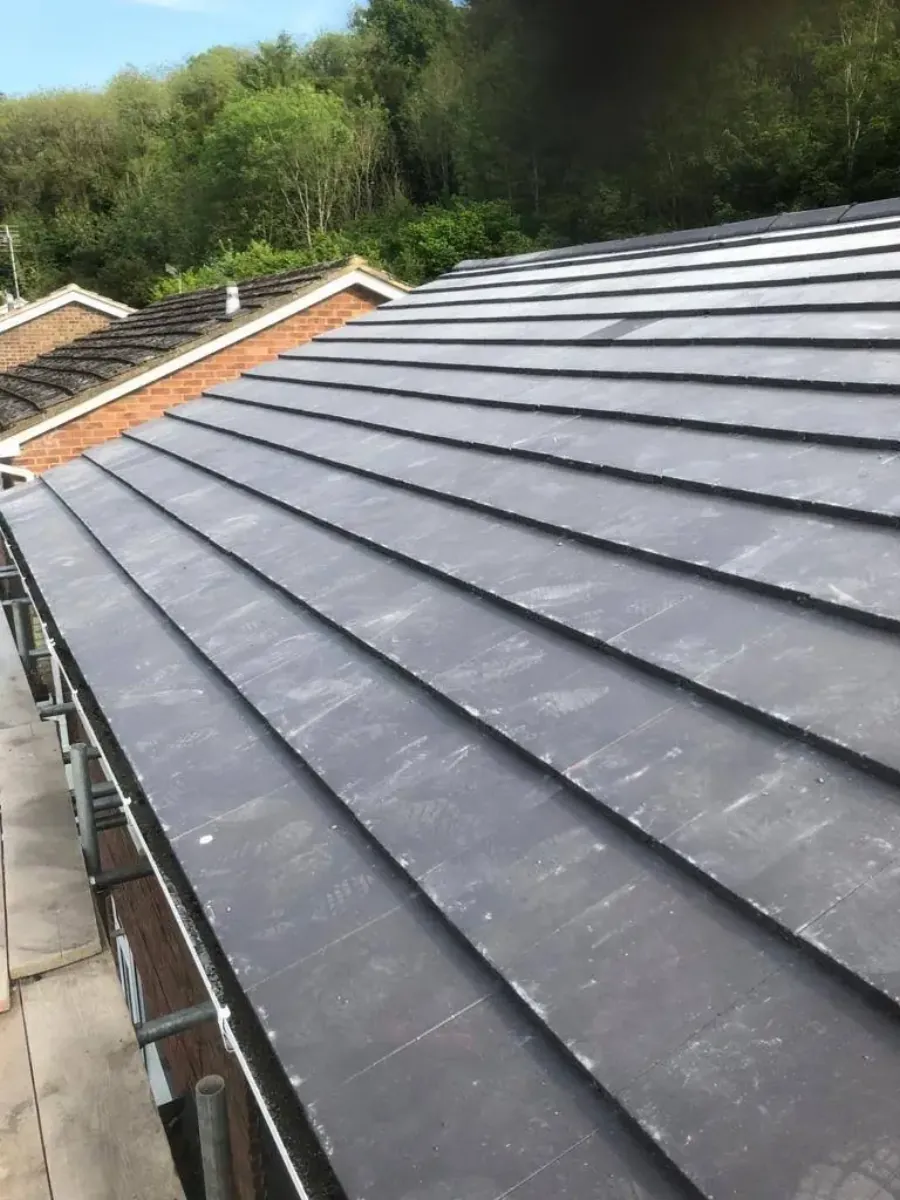
Flat roofs give plenty of notice before they fail properly. These are the signals worth acting on.
Water still sitting on the roof two days after it stopped raining means the falls have gone. That pond will find a weakness eventually.
Raised areas in old felt mean moisture is trapped between layers. Each hot day expands it further and stretches the covering.
Old pour-and-roll felt goes brittle and cracks along its joints. Once one lap opens, water is inside the build-up rather than on top of it.
A drip edge that has come away lets wind under the covering. On an exposed Bagshot plot that can peel a garage roof in a single gale.
If the roof gives underfoot, the boards beneath have taken on water. No covering laid over soft decking will last.
Pine needles and moss silt up flat roof outlets quickly here, and a blocked outlet turns a well-designed fall into a paddling pool.
The order matters. Skipping any of these is how a flat roof ends up being done twice.
The old covering comes off so we can see the deck. Anything soft, delaminated or rotten is replaced rather than covered over.
Firrings or tapered insulation create a positive fall to the outlet. This is the step most commonly skipped, and the reason most flat roofs fail early.
GRP, EPDM, single ply or torch-on felt, bonded or mechanically fixed as the system requires and the exposure demands.
Upstands dressed, metal trims fitted, outlets and kerbs terminated properly. This is where the hours go, and where the roof earns its lifespan.
Send us a photo of the roof and the pooling and we can usually tell you whether it needs a repair or a re-cover before we visit.
From a small porch canopy to a full commercial roof, the same principles apply throughout.
Most of the flat roofs we replace in Bagshot failed for reasons that had nothing to do with the covering chosen.

What people ask us before committing to a flat roof re-cover.
Cannot see your question? We are always happy to talk it through — there is no such thing as a silly question when it comes to your roof.
A properly installed modern system on a sound, correctly falling deck should give you decades rather than years, and the manufacturers back that with product guarantees. The variable is almost never the material — it is whether the deck, falls and detailing beneath it were done correctly.
There is no single answer, which is why we specify per roof. Walked-on balconies suit GRP, simple garages suit EPDM, larger or awkward roofs suit single ply, and outbuildings are well served by torch-on felt. Size, access, use and whether the roof will be seen all feed into it.
Sometimes, and if a patch is genuinely the right answer we will say so. But if the covering has reached the point of blistering and splitting across its area, patching one spot simply moves the leak. We will show you photographs and let you decide with the facts in front of you.
A warm roof puts the insulation above the deck, keeping the structure at room temperature and largely removing condensation risk. A cold roof insulates between the joists and needs a ventilated void. Warm roof build-ups are what we recommend on most re-covers now.
Yes, and doing both together is far cheaper than adding one later. The kerb needs building and detailing into the covering, which is straightforward while the roof is open and disruptive once it is finished.
We do, including converting tired polycarbonate conservatory roofs to solid, insulated roofs. It transforms how usable the room is in both summer and winter, and it is one of the more satisfying jobs we take on.
Not quite what you were after? These are the closest services to this one.